

Tuesday, July 14, 2009

Foreign exchange market
The foreign exchange market (currency, forex, or FX) is where currency trading takes place. It is where banks and other official institutions facilitate the buying and selling of foreign currencies. [1]FX transactions typically involve one party purchasing a quantity of one currency in exchange for paying a quantity of another. The foreign exchange market that we see today started evolving during the 1970s when worldover countries gradually switched to floating exchange rate from their erstwhile exchange rate regime, which remained fixed as per the Bretton Woods system till 1971.
Presently, the FX market is one of the largest and most liquid financial markets in the world, and includes trading between large banks, central banks, currency speculators, corporations, governments, and other institutions. The average daily volume in the global foreign exchange and related markets is continuously growing. Traditional daily turnover was reported to be over US$3.2 trillion in April 2007 by the Bank for International Settlements.[2] Since then, the market has continued to grow. According to Euromoney's annual FX Poll, volumes grew a further 41% between 2007 and 2008.[3]
The purpose of FX market is to facilitate trade and investment. The need for a foreign exchange market arises because of the presence of multifarious international currencies such as US Dollar, Pound Sterling, etc., and the need for trading in such currencies.
Market size and liquidity
The foreign exchange market is unique because of
-
- its trading volumes,
- the extreme liquidity of the market,
- its geographical dispersion,
- its long trading hours: 24 hours a day except on weekends (from 22:00 UTC on Sunday until 22:00 UTC Friday),
- the variety of factors that affect exchange rates.
- the low margins of profit compared with other markets of fixed income (but profits can be high due to very large trading volumes)
- the use of leverage
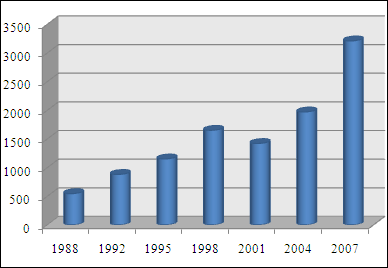

As such, it has been referred to as the market closest to the ideal perfect competition, notwithstanding market manipulation by central banks. According to the Bank for International Settlements,[2] average daily turnover in global foreign exchange markets is estimated at $3.98 trillion. Trading in the world's main financial markets accounted for $3.21 trillion of this. This approximately $3.21 trillion in main foreign exchange market turnover was broken down as follows:
-
- $1.005 trillion in spot transactions
- $362 billion in outright forwards
- $1.714 trillion in foreign exchange swaps
- $129 billion estimated gaps in reporting
Of the $3.98 trillion daily global turnover, trading in London accounted for around $1.36 trillion, or 34.1% of the total, making London by far the global center for foreign exchange. In second and third places respectively, trading in New York accounted for 16.6%, and Tokyo accounted for 6.0%.[4] In addition to "traditional" turnover, $2.1 trillion was traded in derivatives.
Exchange-traded FX futures contracts were introduced in 1972 at the Chicago Mercantile Exchange and are actively traded relative to most other futures contracts.
Several other developed countries also permit the trading of FX derivative products (like currency futures and options on currency futures) on their exchanges. All these developed countries already have fully convertible capital accounts. Most emerging countries do not permit FX derivative products on their exchanges in view of prevalent controls on the capital accounts. However, a few select emerging countries (e.g., Korea, South Africa, India—[1]; [2]) have already successfully experimented with the currency futures exchanges, despite having some controls on the capital account.
FX futures volume has grown rapidly in recent years, and accounts for about 7% of the total foreign exchange market volume, according to The Wall Street Journal Europe (5/5/06, p. 20).
| Rank | Name | Volume |
|---|---|---|
| 1 |  Deutsche Bank Deutsche Bank | 21.70% |
| 2 |  UBS AG UBS AG | 15.80% |
| 3 |  Barclays Capital Barclays Capital | 9.12% |
| 4 |  Citi Citi | 7.49% |
| 5 | Royal Bank of Scotland | 7.30% |
| 6 | JPMorgan | 4.19% |
| 7 | HSBC | 4.10% |
| 8 | Lehman Brothers | 3.58% |
| 9 | Goldman Sachs | 3.47% |
| 10 | Morgan Stanley | 2.86% |
Foreign exchange trading increased by 38% between April 2005 and April 2006 and has more than doubled since 2001. This is largely due to the growing importance of foreign exchange as an asset class and an increase in fund management assets, particularly of hedge funds and pension funds. The diverse selection of execution venues have made it easier for retail traders to trade in the foreign exchange market. In 2006, retail traders constituted over 2% of the whole FX market volumes with an average daily trade volume of over US$50-60 billion (see retail trading platforms).[6] Because foreign exchange is an OTC market where brokers/dealers negotiate directly with one another, there is no central exchange or clearing house. The biggest geographic trading centre is the UK, primarily London, which according to IFSL estimates has increased its share of global turnover in traditional transactions from 31.3% in April 2004 to 34.1% in April 2007. The ten most active traders account for almost 80% of trading volume, according to the 2008 Euromoney FX survey.[3] These large international banks continually provide the market with both bid (buy) and ask (sell) prices. The bid/ask spread is the difference between the price at which a bank or market maker will sell ("ask", or "offer") and the price at which a market-maker will buy ("bid") from a wholesale customer. This spread is minimal for actively traded pairs of currencies, usually 0–3 pips. For example, the bid/ask quote of EUR/USD might be 1.2200/1.2203 on a retail broker. Minimum trading size for most deals is usually 100,000 units of base currency, which is a standard "lot".
These spreads might not apply to retail customers at banks, which will routinely mark up the difference to say 1.2100/1.2300 for transfers, or say 1.2000/1.2400 for banknotes or travelers' checks. Spot prices at market makers vary, but on EUR/USD are usually no more than 3 pips wide (i.e., 0.0003). Competition is greatly increased with larger transactions, and pip spreads shrink on the major pairs to as little as 1 to 2 pips.
Market participants
Unlike a stock market, where all participants have access to the same prices, the foreign exchange market is divided into levels of access. At the top is the inter-bank market, which is made up of the largest investment banking firms. Within the inter-bank market, spreads, which are the difference between the bid and ask prices, are razor sharp and usually unavailable, and not known to players outside the inner circle. The difference between the bid and ask prices widens (from 0-1 pip to 1-2 pips for some currencies such as the EUR). This is due to volume. If a trader can guarantee large numbers of transactions for large amounts, they can demand a smaller difference between the bid and ask price, which is referred to as a better spread. The levels of access that make up the foreign exchange market are determined by the size of the “line” (the amount of money with which they are trading). The top-tier inter-bank market accounts for 53% of all transactions. After that there are usually smaller investment banks, followed by large multi-national corporations (which need to hedge risk and pay employees in different countries), large hedge funds, and even some of the retail FX-metal market makers. According to Galati and Melvin, “Pension funds, insurance companies, mutual funds, and other institutional investors have played an increasingly important role in financial markets in general, and in FX markets in particular, since the early 2000s.” (2004) In addition, he notes, “Hedge funds have grown markedly over the 2001–2004 period in terms of both number and overall size” Central banks also participate in the foreign exchange market to align currencies to their economic needs.
[edit] Banks
The interbank market caters for both the majority of commercial turnover and large amounts of speculative trading every day. A large bank may trade billions of dollars daily. Some of this trading is undertaken on behalf of customers, but much is conducted by proprietary desks, trading for the bank's own account. Until recently, foreign exchange brokers did large amounts of business, facilitating interbank trading and matching anonymous counterparts for small fees. Today, however, much of this business has moved on to more efficient electronic systems. The broker squawk box lets traders listen in on ongoing interbank trading and is heard in most trading rooms, but turnover is noticeably smaller than just a few years ago.
Commercial companies
An important part of this market comes from the financial activities of companies seeking foreign exchange to pay for goods or services. Commercial companies often trade fairly small amounts compared to those of banks or speculators, and their trades often have little short term impact on market rates. Nevertheless, trade flows are an important factor in the long-term direction of a currency's exchange rate. Some multinational companies can have an unpredictable impact when very large positions are covered due to exposures that are not widely known by other market participants.
[edit] Central banks
National central banks play an important role in the foreign exchange markets. They try to control the money supply, inflation, and/or interest rates and often have official or unofficial target rates for their currencies. They can use their often substantial foreign exchange reserves to stabilize the market. Milton Friedman argued that the best stabilization strategy would be for central banks to buy when the exchange rate is too low, and to sell when the rate is too high—that is, to trade for a profit based on their more precise information. Nevertheless, the effectiveness of central bank "stabilizing speculation" is doubtful because central banks do not go bankrupt if they make large losses, like other traders would, and there is no convincing evidence that they do make a profit trading.
The mere expectation or rumor of central bank intervention might be enough to stabilize a currency, but aggressive intervention might be used several times each year in countries with a dirty float currency regime. Central banks do not always achieve their objectives. The combined resources of the market can easily overwhelm any central bank.[7] Several scenarios of this nature were seen in the 1992–93 ERM collapse, and in more recent times in Southeast Asia.
[edit] Hedge funds as speculators
About 70% to 90% of the foreign exchange transactions are speculative. In other words, the person or institution that bought or sold the currency has no plan to actually take delivery of the currency in the end; rather, they were solely speculating on the movement of that particular currency. Hedge funds have gained a reputation for aggressive currency speculation since 1996. They control billions of dollars of equity and may borrow billions more, and thus may overwhelm intervention by central banks to support almost any currency, if the economic fundamentals are in the hedge funds' favor.
[edit] Investment management firms
Investment management firms (who typically manage large accounts on behalf of customers such as pension funds and endowments) use the foreign exchange market to facilitate transactions in foreign securities. For example, an investment manager bearing an international equity portfolio needs to purchase and sell several pairs of foreign currencies to pay for foreign securities purchases.
Some investment management firms also have more speculative specialist currency overlay operations, which manage clients' currency exposures with the aim of generating profits as well as limiting risk. Whilst the number of this type of specialist firms is quite small, many have a large value of assets under management (AUM), and hence can generate large trades.
[edit] Retail foreign exchange brokers
There are two types of retail brokers offering the opportunity for speculative trading: retail foreign exchange brokers and market makers. Retail traders (individuals) are a small fraction of this market and may only participate indirectly through brokers or banks. Retail brokers, while largely controlled and regulated by the CFTC and NFA might be subject to foreign exchange scams.[8][9] At present, the NFA and CFTC are imposing stricter requirements, particularly in relation to the amount of Net Capitalization required of its members. As a result many of the smaller, and perhaps questionable brokers are now gone. It is not widely understood that retail brokers and market makers typically trade against their clients and frequently take the other side of their trades. This can often create a potential conflict of interest and give rise to some of the unpleasant experiences some traders have had. A move toward NDD (No Dealing Desk) and STP (Straight Through Processing) has helped to resolve some of these concerns and restore trader confidence, but caution is still advised in ensuring that all is as it is presented.
[edit] Non-bank Foreign Exchange Companies
Non-bank foreign exchange companies offer currency exchange and international payments to private individuals and companies. These are also known as foreign exchange brokers but are distinct in that they do not offer speculative trading but currency exchange with payments. I.e., there is usually a physical delivery of currency to a bank account.
It is estimated that in the UK, 14% of currency transfers/payments[10] are made via Foreign Exchange Companies.[11] These companies' selling point is usually that they will offer better exchange rates or cheaper payments than the customer's bank. These companies differ from Money Transfer/Remittance Companies in that they generally offer higher-value services.
[edit] Money Transfer/Remittance Companies
Money transfer/remittance companies perform high-volume low-value transfers generally by economic migrants back to their home country. In 2007, the Aite Group estimated that there were $369 billion of remittances (an increase of 8% on the previous year). The four largest markets (India, China, Mexico and the Philippines) receive $95 billion. The largest and best known provider is Western Union with 345,000 agents globally.
[edit] Trading characteristics
| Rank | Currency | ISO 4217 code (Symbol) | % daily share (April 2007) |
|---|---|---|---|
| 1 | United States dollar | USD ($) | 86.3% |
| 2 |  Euro Euro | EUR (€) | 37.0% |
| 3 |  Japanese yen Japanese yen | JPY (¥) | 17.0% |
| 4 | Pound sterling | GBP (£) | 15.0% |
| 5 | Swiss franc | CHF (Fr) | 6.8% |
| 6 |  Australian dollar Australian dollar | AUD ($) | 6.7% |
| 7 |  Canadian dollar Canadian dollar | CAD ($) | 4.2% |
| 8-9 |  Swedish krona Swedish krona | SEK (kr) | 2.8% |
| 8-9 |  Hong Kong dollar Hong Kong dollar | HKD ($) | 2.8% |
| 10 |  Norwegian krone Norwegian krone | NOK (kr) | 2.2% |
| 11 |  New Zealand dollar New Zealand dollar | NZD ($) | 1.9% |
| 12 |  Mexican peso Mexican peso | MXN ($) | 1.3% |
| 13 |  Singapore dollar Singapore dollar | SGD ($) | 1.2% |
| 14 |  South Korean won South Korean won | KRW (₩) | 1.1% |
| Other | 14.5% | ||
| Total | 200% | ||
There is no unified or centrally cleared market for the majority of FX trades, and there is very little cross-border regulation. Due to the over-the-counter (OTC) nature of currency markets, there are rather a number of interconnected marketplaces, where different currencies instruments are traded. This implies that there is not a single exchange rate but rather a number of different rates (prices), depending on what bank or market maker is trading, and where it is. In practice the rates are often very close, otherwise they could be exploited by arbitrageurs instantaneously. Due to London's dominance in the market, a particular currency's quoted price is usually the London market price. A joint venture of the Chicago Mercantile Exchange and Reuters, called Fxmarketspace opened in 2007 and aspired but failed to the role of a central market clearing mechanism.
The main trading center is London, but New York, Tokyo, Hong Kong and Singapore are all important centers as well. Banks throughout the world participate. Currency trading happens continuously throughout the day; as the Asian trading session ends, the European session begins, followed by the North American session and then back to the Asian session, excluding weekends.
Fluctuations in exchange rates are usually caused by actual monetary flows as well as by expectations of changes in monetary flows caused by changes in gross domestic product (GDP) growth, inflation (purchasing power parity theory), interest rates (interest rate parity, Domestic Fisher effect, International Fisher effect), budget and trade deficits or surpluses, large cross-border M&A deals and other macroeconomic conditions. Major news is released publicly, often on scheduled dates, so many people have access to the same news at the same time. However, the large banks have an important advantage; they can see their customers' order flow.
Currencies are traded against one another. Each pair of currencies thus constitutes an individual product and is traditionally noted XXX/YYY, where YYY is the ISO 4217 international three-letter code of the currency into which the price of one unit of XXX is expressed (called base currency). For instance, EUR/USD is the price of the euro expressed in US dollars, as in 1 euro = 1.5465 dollar. Out of convention, the first currency in the pair, the base currency, was the stronger currency at the creation of the pair. The second currency, counter currency, was the weaker currency at the creation of the pair.
The factors affecting XXX will affect both XXX/YYY and XXX/ZZZ. This causes positive currency correlation between XXX/YYY and XXX/ZZZ.
On the spot market, according to the BIS study, the most heavily traded products were:
-
- EUR/USD: 27%
- USD/JPY: 13%
- GBP/USD (also called sterling or cable): 12%
and the US currency was involved in 86.3% of transactions, followed by the euro (37.0%), the yen (17.0%), and sterling (15.0%) (see table). Note that volume percentages should add up to 200%: 100% for all the sellers and 100% for all the buyers.
Trading in the euro has grown considerably since the currency's creation in January 1999, and how long the foreign exchange market will remain dollar-centered is open to debate. Until recently, trading the euro versus a non-European currency ZZZ would have usually involved two trades: EUR/USD and USD/ZZZ. The exception to this is EUR/JPY, which is an established traded currency pair in the interbank spot market. As the dollar's value has eroded during 2008, interest in using the euro as reference currency for prices in commodities (such as oil), as well as a larger component of foreign reserves by banks, has increased dramatically. Transactions in the currencies of commodity-producing countries, such as AUD, NZD, CAD, have also increased.
[edit] Determinants of FX Rates
See also: exchange rates
The following theories explain the fluctuations in FX rates in a floating exchange rate regime (In a fixed exchange rate regime, FX rates are decided by its government):
(a) International parity conditions viz; purchasing power parity, interest rate parity, Domestic Fisher effect, International Fisher effect. Though to some extent the above theories provide logical explanation for the fluctuations in exchange rates, yet these theories falter as they are based on challengeable assumptions [e.g., free flow of goods, services and capital] which seldom hold true in the real world.
(b) Balance of payments model (see exchange rate). This model, however, focuses largely on tradable goods and services, ignoring the increasing role of global capital flows. It failed to provide any explanation for continuous appreciation of dollar during 1980s and most part of 1990s in face of soaring US current account deficit.
(c) Asset market model (see exchange rate) views currencies as an important asset class for constructing investment portfolios. Assets prices are influenced mostly by people’s willingness to hold the existing quantities of assets, which in turn depends on their expectations on the future worth of these assets. The asset market model of exchange rate determination states that “the exchange rate between two currencies represents the price that just balances the relative supplies of, and demand for, assets denominated in those currencies.”
None of the models developed so far succeed to explain FX rates levels and volatility in the longer time frames. For shorter time frames (less than a few days) algorithm can be devised to predict prices. Large and small institutions and professional individual traders have made consistent profits from it. It is understood from above models that many macroeconomic factors affect the exchange rates and in the end currency prices are a result of dual forces of demand and supply. The world's currency markets can be viewed as a huge melting pot: in a large and ever-changing mix of current events, supply and demand factors are constantly shifting, and the price of one currency in relation to another shifts accordingly. No other market encompasses (and distills) as much of what is going on in the world at any given time as foreign exchange.
Supply and demand for any given currency, and thus its value, are not influenced by any single element, but rather by several. These elements generally fall into three categories: economic factors, political conditions and market psychology.
[edit] Economic factors
These include: (a)economic policy, disseminated by government agencies and central banks, (b)economic conditions, generally revealed through economic reports, and other economic indicators.
- Economic policy comprises government fiscal policy (budget/spending practices) and monetary policy (the means by which a government's central bank influences the supply and "cost" of money, which is reflected by the level of interest rates).
- Economic conditions include:
- Government budget deficits or surpluses
- The market usually reacts negatively to widening government budget deficits, and positively to narrowing budget deficits. The impact is reflected in the value of a country's currency.
- Balance of trade levels and trends
- The trade flow between countries illustrates the demand for goods and services, which in turn indicates demand for a country's currency to conduct trade. Surpluses and deficits in trade of goods and services reflect the competitiveness of a nation's economy. For example, trade deficits may have a negative impact on a nation's currency.
- Inflation levels and trends
- Typically a currency will lose value if there is a high level of inflation in the country or if inflation levels are perceived to be rising [. This is because inflation erodes purchasing power, thus demand, for that particular currency. However, a currency may sometimes strengthen when inflation rises because of expectations that the central bank will raise short-term interest rates to combat rising inflation.
- Economic growth and health
- Reports such as GDP, employment levels, retail sales, capacity utilization and others, detail the levels of a country's economic growth and health. Generally, the more healthy and robust a country's economy, the better its currency will perform, and the more demand for it there will be.
- Productivity of an economy
- Increasing productivity in an economy should positively influence the value of its currency. It affects are more prominent if the increase is in the traded sector [3].
[
[edit] Political conditions
Internal, regional, and international political conditions and events can have a profound effect on currency markets.
All exchange rates are susceptible to political instability and anticipations about the new ruling party. Political upheaval and instability can have a negative impact on a nation's economy. For example, destabilization of coalition governments in India, Pakistan and Thailand can negatively affect the value of their currencies. Similarly, in a country experiencing financial difficulties, the rise of a political faction that is perceived to be fiscally responsible can have the opposite effect. Also, events in one country in a region may spur positive or negative interest in a neighboring country and, in the process, affect its currency.
[edit] Market psychology
Market psychology and trader perceptions influence the foreign exchange market in a variety of ways:
- Flights to quality
- Unsettling international events can lead to a "flight to quality," with investors seeking a "safe haven". There will be a greater demand, thus a higher price, for currencies perceived as stronger over their relatively weaker counterparts. The Swiss franc has been a traditional safe haven during times of political or economic uncertainty.[12]
- Long-term trends
- Currency markets often move in visible long-term trends. Although currencies do not have an annual growing season like physical commodities, business cycles do make themselves felt. Cycle analysis looks at longer-term price trends that may rise from economic or political trends. [13]
- "Buy the rumor, sell the fact"
- This market truism can apply to many currency situations. It is the tendency for the price of a currency to reflect the impact of a particular action before it occurs and, when the anticipated event comes to pass, react in exactly the opposite direction. This may also be referred to as a market being "oversold" or "overbought".[14] To buy the rumor or sell the fact can also be an example of the cognitive bias known as anchoring, when investors focus too much on the relevance of outside events to currency prices.
- Economic numbers
- While economic numbers can certainly reflect economic policy, some reports and numbers take on a talisman-like effect: the number itself becomes important to market psychology and may have an immediate impact on short-term market moves. "What to watch" can change over time. In recent years, for example, money supply, employment, trade balance figures and inflation numbers have all taken turns in the spotlight.
- Technical trading considerations
- As in other markets, the accumulated price movements in a currency pair such as EUR/USD can form apparent patterns that traders may attempt to use. Many traders study price charts in order to identify such patterns.[15]
[
[edit] Algorithmic trading in foreign exchange
Electronic trading is growing in the FX market, and algorithmic trading is becoming much more common. According to financial consultancy Celent estimates, by 2008 up to 25% of all trades by volume will be executed using algorithm, up from about 18% in 2005.[citation needed]
An algorithmic trader needs to be mindful of potential fraud by the broker. Part of the weekly algorithm should include a check to see if the amount of transaction errors when the trader is losing money occurs in the same proportion as when the trader would have made money.
Electronic trading is growing in the FX market, and algorithmic trading is becoming much more common. According to financial consultancy Celent estimates, by 2008 up to 25% of all trades by volume will be executed using algorithm, up from about 18% in 2005.[citation needed]
An algorithmic trader needs to be mindful of potential fraud by the broker. Part of the weekly algorithm should include a check to see if the amount of transaction errors when the trader is losing money occurs in the same proportion as when the trader would have made money.
[edit] Financial instruments
[edit] Spot
A spot transaction is a two-day delivery transaction (except in the case of trades between the US Dollar, Canadian Dollar, Turkish Lira and Russian Ruble, which settle the next business day), as opposed to the futures contracts, which are usually three months. This trade represents a “direct exchange” between two currencies, has the shortest time frame, involves cash rather than a contract; and interest is not included in the agreed-upon transaction. The data for this study come from the spot market. Spot transactions has the second largest turnover by volume after Swap transactions among all FX transactions in the Global FX market. NNM
[edit] Forward
See also: forward contract
One way to deal with the foreign exchange risk is to engage in a forward transaction. In this transaction, money does not actually change hands until some agreed upon future date. A buyer and seller agree on an exchange rate for any date in the future, and the transaction occurs on that date, regardless of what the market rates are then. The duration of the trade can be a one day, a few days, months or years. Usually the date is decided by both parties.
[edit] Future
Main article: currency future
Foreign currency futures are exchange traded forward transactions with standard contract sizes and maturity dates — for example, $1000 for next November at an agreed rate [4],[5]. Futures are standardized and are usually traded on an exchange created for this purpose. The average contract length is roughly 3 months. Futures contracts are usually inclusive of any interest amounts.
[edit] Swap
Main article: foreign exchange swap
The most common type of forward transaction is the currency swap. In a swap, two parties exchange currencies for a certain length of time and agree to reverse the transaction at a later date. These are not standardized contracts and are not traded through an exchange.
Main article: currency future
Foreign currency futures are exchange traded forward transactions with standard contract sizes and maturity dates — for example, $1000 for next November at an agreed rate [4],[5]. Futures are standardized and are usually traded on an exchange created for this purpose. The average contract length is roughly 3 months. Futures contracts are usually inclusive of any interest amounts.
[edit] Swap
Main article: foreign exchange swap
The most common type of forward transaction is the currency swap. In a swap, two parties exchange currencies for a certain length of time and agree to reverse the transaction at a later date. These are not standardized contracts and are not traded through an exchange.
[edit] Option
A foreign exchange option (commonly shortened to just FX option) is a derivative where the owner has the right but not the obligation to exchange money denominated in one currency into another currency at a pre-agreed exchange rate on a specified date. The FX options market is the deepest, largest and most liquid market for options of any kind in the world.
[edit] Exchange-Traded Fund
Exchange-traded funds (or ETFs) are open ended investment companies that can be traded at any time throughout the course of the day. Typically, ETFs try to replicate a stock market index such as the S&P 500 (e.g., SPY), but recently they are now replicating investments in the currency markets with the ETF increasing in value when the US Dollar weakens versus a specific currency, such as the Euro. Certain of these funds track the price movements of world currencies versus the US Dollar, and increase in value directly counter to the US Dollar, allowing for speculation in the US Dollar for US and US Dollar denominated investors and speculators.
[edit] Speculation
Controversy about currency speculators and their effect on currency devaluations and national economies recurs regularly. Nevertheless, economists including Milton Friedman have argued that speculators ultimately are a stabilizing influence on the market and perform the important function of providing a market for hedgers and transferring risk from those people who don't wish to bear it, to those who do.[16] Other economists such as Joseph Stiglitz consider this argument to be based more on politics and a free market philosophy than on economics.[17]
Large hedge funds and other well capitalized "position traders" are the main professional speculators.
Currency speculation is considered a highly suspect activity in many countries.[where?] While investment in traditional financial instruments like bonds or stocks often is considered to contribute positively to economic growth by providing capital, currency speculation does not; according to this view, it is simply gambling that often interferes with economic policy. For example, in 1992, currency speculation forced the Central Bank of Sweden to raise interest rates for a few days to 500% per annum, and later to devalue the krona.[18] Former Malaysian Prime Minister Mahathir Mohamad is one well known proponent of this view. He blamed the devaluation of the Malaysian ringgit in 1997 on George Soros and other speculators.
Gregory J. Millman reports on an opposing view, comparing speculators to "vigilantes" who simply help "enforce" international agreements and anticipate the effects of basic economic "laws" in order to profit.[19]
In this view, countries may develop unsustainable financial bubbles or otherwise mishandle their national economies, and foreign exchange speculators allegedly made the inevitable collapse happen sooner. A relatively quick collapse might even be preferable to continued economic mishandling. Mahathir Mohamad and other critics of speculation are viewed as trying to deflect the blame from themselves for having caused the unsustainable economic conditions. Given that Malaysia recovered quickly after imposing currency controls directly against IMF advice, this view is open to doubt.
The world's most traded market, trading 24 hours a day
With average daily turnover of US$3.2 trillion, forex is the most traded market in the world.
A true 24-hour market from Sunday 5 PM ET to Friday 5 PM ET, forex trading begins in Sydney, and moves around the globe as the business day begins, first to Tokyo, London, and New York.
Unlike other financial markets, investors can respond immediately to currency fluctuations, whenever they occur - day or night.
A true 24-hour market from Sunday 5 PM ET to Friday 5 PM ET, forex trading begins in Sydney, and moves around the globe as the business day begins, first to Tokyo, London, and New York.
Unlike other financial markets, investors can respond immediately to currency fluctuations, whenever they occur - day or night.
Understanding Forex Quotes
Reading a foreign exchange quote is simple if you remember two things:
When USD is the base currency and the quote goes up, that means USD has strengthened in value and the other currency has weakened. Rising quotes mean a US dollar can now buy more of the other currency than before.
- The first currency listed is the base currency
- The value of the base currency is always 1.
When USD is the base currency and the quote goes up, that means USD has strengthened in value and the other currency has weakened. Rising quotes mean a US dollar can now buy more of the other currency than before.
Carry Trade Panic Selling?
Did anyone notice the panic selling out there?All kinds of carry trades unwound several hundred points in a very short period of time. Speculation in the Forex news rags suggests that losses due to the falling stock exchanges forced people to unwind their carry trades to cover their margins.In any case, after days of regimented downward movement, the sudden fallout represented a panic moment -- for someone. In the short term, at the very least, this should represent opportunity. I've stuck my toe in.
Did anyone notice the panic selling out there?All kinds of carry trades unwound several hundred points in a very short period of time. Speculation in the Forex news rags suggests that losses due to the falling stock exchanges forced people to unwind their carry trades to cover their margins.In any case, after days of regimented downward movement, the sudden fallout represented a panic moment -- for someone. In the short term, at the very least, this should represent opportunity. I've stuck my toe in.
Forex Market Deconstruction

Now that the trading week is over I thought I'd write about a few things that came to mind over the last couple of days.Current SituationEveryone is expecting the Fed to come along and put a multi-hundred billion dollar package together with the help of congress. Obviously, this is relieving a lot of the unprecedented pressure on both stocks and various Forex markets. The only fly in the ointment I'd keep an eye on is whether or not things get delayed for any period of time
TRADING ONLY WITH MOVING AVERAGE
At the moment I am rather busy. Moving to a new place and house. The house still needs a lot of work. As a result, I do not have time to update this blog. Trading is still going on but on a shorter timeframe. Result is consistent now. AudUsd is very kind at the moment with no sudden movement.
In the next few weeks I will show you how to trade using only MA. As usual what works for me may not work for you. This is because some of you may not be able to follow the rules of the game.
RULES OF THE GAME
1. Trade based on your capital and the time that you have. The bigger your capital the longer the TF. The more time you have the longer the TF. Vice versa.
2. Only trade at the direction pointed by the MA pairs. If the MA pairs is showing mixed direction, do not trade. The MA pairs must be pointing at the same direction.
3. If a trade suddenly change direction, do not hesitate to close it at a loss and turn the trade. This is the hardest part where most of you failed. Free your mind or become a loser all your life.
4. Keep in mind, there is no such thing as winning all the time. Just make sure you win a lot more than you lose. In the end your profit will grow along with your confident.
Simple system with simple rules. I like to keep it simple. No point of having the most complex system when simple system can have the same result. With this system you will be out of the market most of the time. This is because you will only be taking the big move and avoiding the small move and market noise.
Last advise. Do not anticipate. Forex is not a game of inteligence eventhough this system at full swing will show you possible turning point. I am having a possible turning point for audusd at 0.7200 but I will not take it coz there will be market swing before the actual turn. Why wast time waiting for the big move when you can actually see when its going to move.
In the mean time, good luck for all of you. I will be back once my pc is online again. At the moment I am posting this on a laptop. I dont like laptop, too small keypad, makes it hard to do speed typing.
In the next few weeks I will show you how to trade using only MA. As usual what works for me may not work for you. This is because some of you may not be able to follow the rules of the game.
RULES OF THE GAME
1. Trade based on your capital and the time that you have. The bigger your capital the longer the TF. The more time you have the longer the TF. Vice versa.
2. Only trade at the direction pointed by the MA pairs. If the MA pairs is showing mixed direction, do not trade. The MA pairs must be pointing at the same direction.
3. If a trade suddenly change direction, do not hesitate to close it at a loss and turn the trade. This is the hardest part where most of you failed. Free your mind or become a loser all your life.
4. Keep in mind, there is no such thing as winning all the time. Just make sure you win a lot more than you lose. In the end your profit will grow along with your confident.
Simple system with simple rules. I like to keep it simple. No point of having the most complex system when simple system can have the same result. With this system you will be out of the market most of the time. This is because you will only be taking the big move and avoiding the small move and market noise.
Last advise. Do not anticipate. Forex is not a game of inteligence eventhough this system at full swing will show you possible turning point. I am having a possible turning point for audusd at 0.7200 but I will not take it coz there will be market swing before the actual turn. Why wast time waiting for the big move when you can actually see when its going to move.
In the mean time, good luck for all of you. I will be back once my pc is online again. At the moment I am posting this on a laptop. I dont like laptop, too small keypad, makes it hard to do speed typing.
Tips for New Forex Traders
Forex has always been a magnet for investors and traders, who are looking for an exciting business venture to invest in, giving them the thrill, adventure and excitement, along with an idea of a quick and easy way to make profits.
But, for those who are relatively new to the Forex trading world, it is extremely important to know exactly what you are getting into. When it comes to the matter of investing a huge amount of your hard earned money into something, first time investors should always make sure what they ought to expect out of it. What should and should not be done. What steps should be taken to play safe and what to do that keeps them at away from the frauds and scams.
First of all what needs to be learnt is, what is Forex and how does it work? What need’s to be known next are a few important trading tips, which will facilitate you during your transactions.
Foreign Exchange or Forex or FX is one of the biggest money market in the world, and is a platform where currency is sold and bought freely between buyers and sellers. Forex, unlike any other financial markets, has no physical location or central exchange.
With over $1.5 trillion USD being traded daily, the foreign exchange market has now become a market which is open to trading by an average investor as much as it is open to a high investor.
Launched over three decades back, in the early seventies, Market Forex introduced free exchange rates worldwide, according to which, the price of the currencies was determined on the basis of demand and supply only.
A number of reasons are responsible for making Forex a distinctive financial market. To begin with, no external regulatory authority is allowed to set or fix currency prices or rates in this market, making Forex is market which cannot be controlled in any way. Also, it is one of those few money markets that necessitate very little trading education, training and experience.
In order to know the Forex market well, the new traders should know how to start trading Forex. The few important things to be kept in mind when beginning to trade Forex are as follows:
What needs to be done firstly is, to open a Forex account. This can be done by filling up an application form, providing the required essential credentials, like personal details, financial particulars, and other details such as whether or not, a broker will be allowed to mediate with any trade if it appears to get too precarious and dicey.
Once your account has been created and recognized, you can begin to flow cash in to it and start trading Forex.
New Forex traders are always advised to create two accounts while trading, one of them being a real account, while the other being a demo one. A real account will facilitate the trader to actually trade in the market, with real money.
The demo account helps the new investor learn more about the trading business. This way the new trader can practice his moves of trading in the market, without the fear of losing all his money in case he/ she goofs up or ends up making the wrong deal.
Also, before you start trading in the market, you should have a closer look at all the top five foreign currencies and their current rates to make sure, you are aware of the current rates and are not missing anything.
The top five Forex currencies are: Pound/USD, Swiss franc/USD, Euro/Yen, USD/Yen and Euro/USD.
Always keep a check on the market. With the time intervals on hourly, daily and weekly schedules with all the currencies that are in any way related to your trade.
Being a successful trader requires to come up with individual and unique trading strategies. There is no “Golden Mantra” or “Trade Secret”, which will work for the traders.
Every investor needs to come up with their own, personal and distinctive trading approach when it comes to the market. There are different ways by which, the traders approach the market. Sometimes they may bank solely on industrial and technical analysis.
Some may like better to go in for a more elementary and basic approach for trading, while others may make use of the past records of the market, combined with both technical as well as fundamental techniques for trading.
All these strategies help the traders in studying the patterns of currency price trends and movements, making it easier for them to foresee the course of the potential developments in the Forex market.
Currency prices in Forex market mostly move in trends. They have a pattern, through which, certain movements can be studied. Some of these movements which have been studied over several years mostly help in discovering that pattern in the market trend. These trends are what should be recognized and valued properly, to facilitate the creation of an excellent trading strategy.
Any factors, financial or political, having some control over the value or the price of a currency, have already been measured by the market to be included as an important factor in creating a price trend.
When trading for the first time, it is always advisable to invest by the trends. Trading with a trend can facilitate you by advancing your chances with profit. Many new investors are enthusiastic to start trading as soon as they can, eventually ending up trading in any direction.
Trading by a trend or following a pattern and studying the market can increase your odds of being favored by the market, making your trading prospects high.
But, for those who are relatively new to the Forex trading world, it is extremely important to know exactly what you are getting into. When it comes to the matter of investing a huge amount of your hard earned money into something, first time investors should always make sure what they ought to expect out of it. What should and should not be done. What steps should be taken to play safe and what to do that keeps them at away from the frauds and scams.
First of all what needs to be learnt is, what is Forex and how does it work? What need’s to be known next are a few important trading tips, which will facilitate you during your transactions.
Foreign Exchange or Forex or FX is one of the biggest money market in the world, and is a platform where currency is sold and bought freely between buyers and sellers. Forex, unlike any other financial markets, has no physical location or central exchange.
With over $1.5 trillion USD being traded daily, the foreign exchange market has now become a market which is open to trading by an average investor as much as it is open to a high investor.
Launched over three decades back, in the early seventies, Market Forex introduced free exchange rates worldwide, according to which, the price of the currencies was determined on the basis of demand and supply only.
A number of reasons are responsible for making Forex a distinctive financial market. To begin with, no external regulatory authority is allowed to set or fix currency prices or rates in this market, making Forex is market which cannot be controlled in any way. Also, it is one of those few money markets that necessitate very little trading education, training and experience.
In order to know the Forex market well, the new traders should know how to start trading Forex. The few important things to be kept in mind when beginning to trade Forex are as follows:
What needs to be done firstly is, to open a Forex account. This can be done by filling up an application form, providing the required essential credentials, like personal details, financial particulars, and other details such as whether or not, a broker will be allowed to mediate with any trade if it appears to get too precarious and dicey.
Once your account has been created and recognized, you can begin to flow cash in to it and start trading Forex.
New Forex traders are always advised to create two accounts while trading, one of them being a real account, while the other being a demo one. A real account will facilitate the trader to actually trade in the market, with real money.
The demo account helps the new investor learn more about the trading business. This way the new trader can practice his moves of trading in the market, without the fear of losing all his money in case he/ she goofs up or ends up making the wrong deal.
Also, before you start trading in the market, you should have a closer look at all the top five foreign currencies and their current rates to make sure, you are aware of the current rates and are not missing anything.
The top five Forex currencies are: Pound/USD, Swiss franc/USD, Euro/Yen, USD/Yen and Euro/USD.
Always keep a check on the market. With the time intervals on hourly, daily and weekly schedules with all the currencies that are in any way related to your trade.
Being a successful trader requires to come up with individual and unique trading strategies. There is no “Golden Mantra” or “Trade Secret”, which will work for the traders.
Every investor needs to come up with their own, personal and distinctive trading approach when it comes to the market. There are different ways by which, the traders approach the market. Sometimes they may bank solely on industrial and technical analysis.
Some may like better to go in for a more elementary and basic approach for trading, while others may make use of the past records of the market, combined with both technical as well as fundamental techniques for trading.
All these strategies help the traders in studying the patterns of currency price trends and movements, making it easier for them to foresee the course of the potential developments in the Forex market.
Currency prices in Forex market mostly move in trends. They have a pattern, through which, certain movements can be studied. Some of these movements which have been studied over several years mostly help in discovering that pattern in the market trend. These trends are what should be recognized and valued properly, to facilitate the creation of an excellent trading strategy.
Any factors, financial or political, having some control over the value or the price of a currency, have already been measured by the market to be included as an important factor in creating a price trend.
When trading for the first time, it is always advisable to invest by the trends. Trading with a trend can facilitate you by advancing your chances with profit. Many new investors are enthusiastic to start trading as soon as they can, eventually ending up trading in any direction.
Trading by a trend or following a pattern and studying the market can increase your odds of being favored by the market, making your trading prospects high.
FOREX-Asian comments provide a big boost to the dollar
FOREX-Asian comments provide a big boost to the dollar
The dollar recovered from its lowest levels this year against the euro on Wednesday after monetary sources in Asia said they would keep buying U.S. Treasuries even if the U.S. credit rating were to be cut.
The remarks from sources in China, Japan, India and South Korea [ID:nSP412010], compiled by Reuters from separate interviews, helped to stem recent selling that has driven the dollar index .DXY to its lowest this year and down more than 7 percent since the start of May.
Traders viewed the comments as an expression of support for dollar-denominated assets from the nations that control about half of the world's currency reserves. Dollar weakness would erode the value of U.S. investments.
"As the dollar continues to weaken, vocal intervention of this sort will rise," said Jacob Oubina, currency strategist at Forex.com in Bedminster, New Jersey. "This at least sets some kind of ceiling on euro strength and puts a floor under dollar weakness."
The euro pulled away from a five-month high it had hit in early trade and selling accelerated after the Reuters story was published. Sterling retreated from a seven-month high against the U.S. currency.
In early New York trade, the euro traded 0.7 percent lower at $1.4210 on electronic trading platform EBS , after hitting a session low $1.4177 and falling from $1.4339 hit in early trade, its strongest since December.
The dollar index, which tracks the currency's moves against a basket of six currencies, rose as much as half a percent after the comments, keeping just above its lowest level of the year hit on Tuesday. .DXY
Some of the dollar's slide in past weeks has been attributed to speculation that the U.S. credit rating may be downgraded, a move that may prompt nations to diversify their foreign reserves away from U.S. Treasuries.
The comments by the monetary sources in Asia came after a visit by U.S. Treasury Secretary Timothy Geithner to China, the world's biggest holder of Treasuries, during which he assured Beijing its U.S. investments were safe because Washington is committed to a strong dollar policy.
Analysts said that the dollar-positive comments had prompted traders to lock in profits against the suffering U.S. currency and that it might help to stem its recent selling for the time being but was unlikely to change the trend.
"The market is becoming somewhat stretched on short dollar positions as there has been decent-sized buying in euro and sterling, so traders were looking for a reason to calm things down," said Geoffrey Yu, currency strategist at UBS in London.
FOREX-Asian comments provide a big boost to the dollar
The dollar recovered from its lowest levels this year against the euro on Wednesday after monetary sources in Asia said they would keep buying U.S. Treasuries even if the U.S. credit rating were to be cut.
The remarks from sources in China, Japan, India and South Korea [ID:nSP412010], compiled by Reuters from separate interviews, helped to stem recent selling that has driven the dollar index .DXY to its lowest this year and down more than 7 percent since the start of May.
Traders viewed the comments as an expression of support for dollar-denominated assets from the nations that control about half of the world's currency reserves. Dollar weakness would erode the value of U.S. investments.
"As the dollar continues to weaken, vocal intervention of this sort will rise," said Jacob Oubina, currency strategist at Forex.com in Bedminster, New Jersey. "This at least sets some kind of ceiling on euro strength and puts a floor under dollar weakness."
The euro pulled away from a five-month high it had hit in early trade and selling accelerated after the Reuters story was published. Sterling retreated from a seven-month high against the U.S. currency.
In early New York trade, the euro traded 0.7 percent lower at $1.4210 on electronic trading platform EBS , after hitting a session low $1.4177 and falling from $1.4339 hit in early trade, its strongest since December.
The dollar index, which tracks the currency's moves against a basket of six currencies, rose as much as half a percent after the comments, keeping just above its lowest level of the year hit on Tuesday. .DXY
Some of the dollar's slide in past weeks has been attributed to speculation that the U.S. credit rating may be downgraded, a move that may prompt nations to diversify their foreign reserves away from U.S. Treasuries.
The comments by the monetary sources in Asia came after a visit by U.S. Treasury Secretary Timothy Geithner to China, the world's biggest holder of Treasuries, during which he assured Beijing its U.S. investments were safe because Washington is committed to a strong dollar policy.
Analysts said that the dollar-positive comments had prompted traders to lock in profits against the suffering U.S. currency and that it might help to stem its recent selling for the time being but was unlikely to change the trend.
"The market is becoming somewhat stretched on short dollar positions as there has been decent-sized buying in euro and sterling, so traders were looking for a reason to calm things down," said Geoffrey Yu, currency strategist at UBS in London.
Forex Trading For Beginners - 10 Essential Tips For Forex Trading Success
If you are new to Forex trading you understand need to understand that 95% of trades lose. If you want to win you can but you need to follow these essential trading tips. Here are your ten tips and there in no particular order of importance, there all important!1. Don't Use a cheap Forex Robot or Expert Advisor If you think you are going to get rich by paying out two hundred dollars or less for a cheap software package think again you won't, all these systems lose money. If Forex trading were as simple as paying a few hundred dollars for a lifelong income, 95% of traders wouldn't lose money. 2. Accept Responsibility Leading on from the above point, it should be pretty obvious that you need to accept responsibility for your actions, learn skills and get a decent Forex education. 3. Work Smart Not Hard You don't need to Work hard just get the right Forex information and that should only take you a couple of weeks at most and your all set. 4. Keep Your Strategy Simple Simple trading strategies work best as they are more robust than complex ones, with fewer elements to break, so keep your system simple. 5. Use Technical analysis This is simply the most time efficient way to trade and all you need to do is learn the right chart formations, to spot profitable chart set ups and that's a learned skill. 6. Be PatientDon't trade to often, once or twice a month is enough to make big gains and is the best way to trade, as you will be focusing on the high odds trades which offer the biggest profits.7. Use tight Money Management You are going to get losses, so make sure you keep them small and always place a stop before you start to trade, so you are not tempted to run losses and hope they turn around - most times they don't!8. Use Sensible Leverage You can get 200: 1 leverage with any Forex broker online but this is far too much and you will eventually destroy your account. 10- 20:1 is plenty for most traders. 9. Learn Discipline You will here this word a lot and it's the key to Forex trading success. You must follow your system with discipline and keep your losses small. If you can't follow your system with discipline you don't have one!10. Be RealisticDon't be afraid to make mistakes or take losses, all traders do and you will too. Forget perfection and focus on making money; if you can make 50 - 100% in your first year of trading you are up there with the best and can be very proud of yourself. These are 10 very simple tips for novice Forex traders and if you follow them you could be on the road to Forex trading success and a great second or even life changing income.
If you are new to Forex trading you understand need to understand that 95% of trades lose. If you want to win you can but you need to follow these essential trading tips. Here are your ten tips and there in no particular order of importance, there all important!1. Don't Use a cheap Forex Robot or Expert Advisor If you think you are going to get rich by paying out two hundred dollars or less for a cheap software package think again you won't, all these systems lose money. If Forex trading were as simple as paying a few hundred dollars for a lifelong income, 95% of traders wouldn't lose money. 2. Accept Responsibility Leading on from the above point, it should be pretty obvious that you need to accept responsibility for your actions, learn skills and get a decent Forex education. 3. Work Smart Not Hard You don't need to Work hard just get the right Forex information and that should only take you a couple of weeks at most and your all set. 4. Keep Your Strategy Simple Simple trading strategies work best as they are more robust than complex ones, with fewer elements to break, so keep your system simple. 5. Use Technical analysis This is simply the most time efficient way to trade and all you need to do is learn the right chart formations, to spot profitable chart set ups and that's a learned skill. 6. Be PatientDon't trade to often, once or twice a month is enough to make big gains and is the best way to trade, as you will be focusing on the high odds trades which offer the biggest profits.7. Use tight Money Management You are going to get losses, so make sure you keep them small and always place a stop before you start to trade, so you are not tempted to run losses and hope they turn around - most times they don't!8. Use Sensible Leverage You can get 200: 1 leverage with any Forex broker online but this is far too much and you will eventually destroy your account. 10- 20:1 is plenty for most traders. 9. Learn Discipline You will here this word a lot and it's the key to Forex trading success. You must follow your system with discipline and keep your losses small. If you can't follow your system with discipline you don't have one!10. Be RealisticDon't be afraid to make mistakes or take losses, all traders do and you will too. Forget perfection and focus on making money; if you can make 50 - 100% in your first year of trading you are up there with the best and can be very proud of yourself. These are 10 very simple tips for novice Forex traders and if you follow them you could be on the road to Forex trading success and a great second or even life changing income.
Forex Trading Indicators and the Ever Changing Market Conditions
Once you enter the Forex trading world you will immediately notice the need of using technical analysis in order to find trends when looking at the forex charts and also the importance of being aware of when they first develop so you can ride the trend until it ends. The foreign exchange market is a very strong trending market, lots of ups and downs in short periods of time, and it's, therefore, a place where technical analysis can be very effective.
But you should always remember that the indicators are only giving you a high probability behavior the markets may show when you are trading, but will never tell you the behavior of the currency prices with total certainty.
If you want to become a profitable forex trader you will need to use as many technical indicators as you can, or create a personalized trading strategy based on a combination of these indicators, to recognize with the best accuracy possible the trend. In other words, a professional forex trader will try to identify the major trend, the intermediate trend, and the short-term trend and then construct his trades in that direction based on how long their rules allow him to hold a position.
The forex markets are always changing, that's why you should always have an open criterion when using your technical indicators. Markets will be changing and different combinations of indicators may be required with time in order to have the most accurate, highest probability, prediction of future currency price behaviors.
If the action of the market shows your judgment to be correct, then you must consider staying with the market' and look for the maximum profit on each trade, according to your risk-to-reward/equity management rules. If you happen to be in a bad day and the market goes against you, the smart trader will take profits and get out of that trade. In a narrow market, when prices are not going anywhere, but move within a narrow range, there is no sense in trying to anticipate when the next big movement is going to be.
So, you must always be alert and open to use as many and as different indicators in order to stay tuned with the market and become a profitable trader at the end of the day.
by Martin Redhead
http://www.forexmentor.com
But you should always remember that the indicators are only giving you a high probability behavior the markets may show when you are trading, but will never tell you the behavior of the currency prices with total certainty.
If you want to become a profitable forex trader you will need to use as many technical indicators as you can, or create a personalized trading strategy based on a combination of these indicators, to recognize with the best accuracy possible the trend. In other words, a professional forex trader will try to identify the major trend, the intermediate trend, and the short-term trend and then construct his trades in that direction based on how long their rules allow him to hold a position.
The forex markets are always changing, that's why you should always have an open criterion when using your technical indicators. Markets will be changing and different combinations of indicators may be required with time in order to have the most accurate, highest probability, prediction of future currency price behaviors.
If the action of the market shows your judgment to be correct, then you must consider staying with the market' and look for the maximum profit on each trade, according to your risk-to-reward/equity management rules. If you happen to be in a bad day and the market goes against you, the smart trader will take profits and get out of that trade. In a narrow market, when prices are not going anywhere, but move within a narrow range, there is no sense in trying to anticipate when the next big movement is going to be.
So, you must always be alert and open to use as many and as different indicators in order to stay tuned with the market and become a profitable trader at the end of the day.
by Martin Redhead
http://www.forexmentor.com
Online Forex Trading - These Two Simple Equations Can Lead You to Huge Gains
Enclosed you will find two equations which most traders don't understand and that's why most traders lose however if you understand them and incorporate them in your Forex trading strategy you could be on the road to huge gains... Let's first of all start with the equation which relates to how and why markets really move and it's this: Supply and Demand Fundamentals + Human Perception of them = Price Simple? Yes it is but most traders fail to see its signifcance which is: It's not the facts that are important, its how humans perceive them that is; always remember humans are creatures of emotion and don't conform to some scientific theory which means all the commonly perceived views below about trading Forex are wrong: - You can predict market movements in advance- You can trade breaking news and the facts - Markets move to some mathematical theory - You can make money from short term moves i.e. scalping or day trading. Its clear that markets move to probabilities not certainties. So using complex theories or mathematical theories is doomed to failure; its also impossible to work out what millions upon millions of traders will do within a day, as all short term moves are random and breaking news stories and facts cannot be traded, as the facts by themselves not important, its how there perceived that determines what happens next. So how do you trade online Forex markets and win? In an odds based market, simple systems works best and you should simply trade the reality of price change on a Forex Chart. Most traders make Forex trading more complicated than it really is. Having a successful trading system though is not enough next, you now need to understand another simple equation to succeed. A Simple Robust Forex Trading System + Disciplined Execution = Forex ProfitsThe key to winning long term at Forex is disciplined execution of a system. If you can't execute your trading system signals with discipline, you have no system and don't be deceived, trading with discipline is very hard. The reason discipline is so hard is you are going to have losing periods ( all traders have them) and you are going to have to keep going while the market takes your money and wrong foots you and makes you feel a fool. When this is happening, you need to keep your losses small and stay on course until you hit a home run and this is hard. Most traders think they will never lose and believe the rubbish that vendors of "sure fire" systems tell them which is - losing periods don't occur or are very short. When they hit a period of losses, they simply cannot cope with them and throw in the towel. if you understand that you have to lose to win and can trade with discipline, you can enjoy currency trading success. Most traders don't really understand how markets really move and lack the mindset to win. Above we have shown you what it takes to win at online Forex trading and the rest is now up to you - good luck!
Enclosed you will find two equations which most traders don't understand and that's why most traders lose however if you understand them and incorporate them in your Forex trading strategy you could be on the road to huge gains... Let's first of all start with the equation which relates to how and why markets really move and it's this: Supply and Demand Fundamentals + Human Perception of them = Price Simple? Yes it is but most traders fail to see its signifcance which is: It's not the facts that are important, its how humans perceive them that is; always remember humans are creatures of emotion and don't conform to some scientific theory which means all the commonly perceived views below about trading Forex are wrong: - You can predict market movements in advance- You can trade breaking news and the facts - Markets move to some mathematical theory - You can make money from short term moves i.e. scalping or day trading. Its clear that markets move to probabilities not certainties. So using complex theories or mathematical theories is doomed to failure; its also impossible to work out what millions upon millions of traders will do within a day, as all short term moves are random and breaking news stories and facts cannot be traded, as the facts by themselves not important, its how there perceived that determines what happens next. So how do you trade online Forex markets and win? In an odds based market, simple systems works best and you should simply trade the reality of price change on a Forex Chart. Most traders make Forex trading more complicated than it really is. Having a successful trading system though is not enough next, you now need to understand another simple equation to succeed. A Simple Robust Forex Trading System + Disciplined Execution = Forex ProfitsThe key to winning long term at Forex is disciplined execution of a system. If you can't execute your trading system signals with discipline, you have no system and don't be deceived, trading with discipline is very hard. The reason discipline is so hard is you are going to have losing periods ( all traders have them) and you are going to have to keep going while the market takes your money and wrong foots you and makes you feel a fool. When this is happening, you need to keep your losses small and stay on course until you hit a home run and this is hard. Most traders think they will never lose and believe the rubbish that vendors of "sure fire" systems tell them which is - losing periods don't occur or are very short. When they hit a period of losses, they simply cannot cope with them and throw in the towel. if you understand that you have to lose to win and can trade with discipline, you can enjoy currency trading success. Most traders don't really understand how markets really move and lack the mindset to win. Above we have shown you what it takes to win at online Forex trading and the rest is now up to you - good luck!
Trade Mechanics
Given that there is in excess of $2 trillion a day being traded on the forex market, it’s easy to believe that there will always be enough liquidity in the market to do what needs doing. Sadly, belief doesn’t negate the truth that for each and every buyer in the market, there MUST also be a seller, otherwise no transaction can occur. If an order is too big to handle at the current price, then the price has to move to a point where there is enough open interest to cover the transaction. Each time you see a price move even a single pip, it’s an indication that an order was transacted or executed which “consumed” the open interest at its existing price. Prices can move in no other way.
As we discussed previously, each bank lists on the Electronic Broking Service how much and at which price the bank is willing to transact in a given currency. It’s important to note that Interbank participants are under no obligation to enter into a transaction if they feel it is not in their best interest. Remember, the Interbank has no “market makers;” only speculators and hedgers.
You may notice that there is generally open interest of different sizes at different prices. Each of those units represents an existing limit order; in this example, then, each unit is representative of $1 million in currency.
Knowing this information, say a market sell order is placed for 38.4 million, then the spread would widen instantaneously from 2.5 to 4.5 pips simply because there would not be any orders that were between the 1.56300 price and the 1.56345 price. The spread wasn’t increased by any broker, bank or market maker; it was a natural byproduct of the sell order that was placed. Provided there were no additional orders, the spread would continue to remain that large. Fortunately, at some point in time, someone somewhere will look at a price point somewhere between those two figures as an ideal opportunity and place an order. Such an order will either consume (remove) interest or increase it; the action it takes will largely depend on whether or not it’s a market order or a limit order, respectively.
You may wonder what might have happened if a sell order for 2 million is placed, just a split second after the 38.4 million order hits? That order would be filled at 1.5630. You may ask why was that order “slipped?” Because no one was willing to take the flip side of the deal (at 1.56320). It’s not that anyone was trying to cheat the trader; again, it was merely a by-product of the order flow.
The more interesting question would be what if all of the listed orders were canceled suddenly? In that case, the spread would increase to the point at which there would exist bids and offers. Now, that might be 5, 8,10 or even, say, 100 pips. It will widen to whatever is the difference between the bid price and the offer price. Nobody came in to “set” the spread; they merely refused to enter into a transaction at any price between it.
You can’t force an order into existence that simply doesn’t exist. Regardless which market is under examination, or what broker is attempting to facilitate a transaction, it is nearly impossible to avoid both spreads and slippage. In the trading world, they are simply a fact of life.
Given that there is in excess of $2 trillion a day being traded on the forex market, it’s easy to believe that there will always be enough liquidity in the market to do what needs doing. Sadly, belief doesn’t negate the truth that for each and every buyer in the market, there MUST also be a seller, otherwise no transaction can occur. If an order is too big to handle at the current price, then the price has to move to a point where there is enough open interest to cover the transaction. Each time you see a price move even a single pip, it’s an indication that an order was transacted or executed which “consumed” the open interest at its existing price. Prices can move in no other way.
As we discussed previously, each bank lists on the Electronic Broking Service how much and at which price the bank is willing to transact in a given currency. It’s important to note that Interbank participants are under no obligation to enter into a transaction if they feel it is not in their best interest. Remember, the Interbank has no “market makers;” only speculators and hedgers.
You may notice that there is generally open interest of different sizes at different prices. Each of those units represents an existing limit order; in this example, then, each unit is representative of $1 million in currency.
Knowing this information, say a market sell order is placed for 38.4 million, then the spread would widen instantaneously from 2.5 to 4.5 pips simply because there would not be any orders that were between the 1.56300 price and the 1.56345 price. The spread wasn’t increased by any broker, bank or market maker; it was a natural byproduct of the sell order that was placed. Provided there were no additional orders, the spread would continue to remain that large. Fortunately, at some point in time, someone somewhere will look at a price point somewhere between those two figures as an ideal opportunity and place an order. Such an order will either consume (remove) interest or increase it; the action it takes will largely depend on whether or not it’s a market order or a limit order, respectively.
You may wonder what might have happened if a sell order for 2 million is placed, just a split second after the 38.4 million order hits? That order would be filled at 1.5630. You may ask why was that order “slipped?” Because no one was willing to take the flip side of the deal (at 1.56320). It’s not that anyone was trying to cheat the trader; again, it was merely a by-product of the order flow.
The more interesting question would be what if all of the listed orders were canceled suddenly? In that case, the spread would increase to the point at which there would exist bids and offers. Now, that might be 5, 8,10 or even, say, 100 pips. It will widen to whatever is the difference between the bid price and the offer price. Nobody came in to “set” the spread; they merely refused to enter into a transaction at any price between it.
You can’t force an order into existence that simply doesn’t exist. Regardless which market is under examination, or what broker is attempting to facilitate a transaction, it is nearly impossible to avoid both spreads and slippage. In the trading world, they are simply a fact of life.
Introduction to the Foreign Exchange Market

The rationale behind this post is to break down the inner workings of the foreign exchange market and perhaps provide some enlightenment on the current situation, the forex market in general, the reason why we have and need forex brokers, and how forex brokers make their profit. More importantly, it aims to provide some understanding as to why we, as forex speculators, can and should, despite a very volatile market, continue to trade.
Rationale
Let’s start with a basic explanation of why the forex market came to be, and how it is used by its principal participants. We’ll continue the explanation into the structure of the market, and how it operates. In conclusion, we’ll look at the implications and how this affects speculators.
The forex market isn’t usually used as a medium for investments, unlike other markets, such as those that trade equity and bonds. While speculation plays a smaller, but nonetheless important role, the vast majority of forex trades are primarily made as a means to facilitate international business transactions.
An example might help to shed a little light on this. Let’s say you’ve got a guy in Detroit who decides he wants to buy a nice shiny new import. He’s got his eye on a Mitsubishi Eclipse and goes to the local Mitsubishi dealership, where he’ll naturally pay for his car with U.S. Dollars. That’s all well and good, but the Japanese workers in the Mitsubishi factory in Japan naturally want to get paid in their own currency, namely Japanese Yen. Somewhere along the line, the U.S. Dollar money from the car purchase has to be converted to Japanese Yen to pay those workers.
If you think about it, huge multi-nationals like Nestle, Exxon-Mobil, Microsoft, Honda, Sony, G-E and tens of thousands of other smaller global entities move nearly every single U.S. Dollar, Japanese Yen, Euro, Pound Sterling, Saudi Arabian Riyal, Brazilian Real and Russian Ruble plus dozens of other foreign currencies you’ve never even heard about, through the foreign exchange markets. In a single day, more than $2.3 trillion in foreign exchange is traded, and that figure is expected to rise to $3 trillion within two years time. It isn’t difficult to comprehend, then, how truly insignificant is the presence of the individual speculators.
The fact is, businesses don’t really care (much) about the variances and intricacies of the foreign exchange rates. They’re in the business to make a product, sell it and reap the profits.
A bank, as the central depository of a company’s cash, is naturally the facilitator of a company’s foreign exchange transactions. Decades ago, it was a matter of a simple telephone call from a banker in one country to another banker in a different country. Banks that had an international presence could merely do a branch to branch transfer.
Remember, banks are in the business to make money, just like any other business. So when a bank bought foreign currency at one price, they naturally added their margin to it before selling it to another customer. That margin is called the spread. For all intents and purposes, that was, and remains, a fairly reasonable cost.
From our earlier example, Mitsubishi gets Japanese Yen in payment for the Eclipse, and is now able to pay its workers who built the car. The car owner is happy, Mitsubishi is happy and the Mitsubishi factor workers are happy. The banks which facilitated the foreign exchange transaction are also happy, because they earned a tidy little profit (the spread) for handling the transaction, and for accepting the associated risks inherent with foreign exchange.
One of the consequences of transacting all this foreign exchange business is that bank traders soon developed an ability to speculate as to the direction of future currency rates. With a better grasp of how the market works, a bank could give a customer a quote adding a spread to the current rate but actually hold off or hedge until a better rate comes along. In so doing, the banks were able to dramatically increase their net income. One unfortunate end result, though, was that the method of redistributing the liquidity made it impossible to complete certain forex transactions.
For that reason alone, the foreign exchange market needed to be made available to non-bank participants. Naturally, the banks wanted to be able to execute more orders in the forex market which would allow them to profit from less experienced participants (who provided a better distribution of the liquidity) and which permitted them to execute their hedge orders from their international customers.
Create your Own System for Better Trading

If anyone wants to be a trader in the world of currency trading then he or she must know that this is not a breeze game or as easy to rolling one’s bed. Trading in the Foreign Exchange Market is actually serious business. So, you should respect and give extra attention about it. People who don’t take the business with enough respect ends up losing their investments soon. It can be the best thing you do in your entire life whereas at the same time, it can turn into your worst nightmare. Which one will be it totally depend on your performance. To beat the forex market you must bring into the light yourself with the different concepts of this deal, the basic trading skills, the pros and cons of the business, a lot of discipline and the sufficient knowledge to create your own forex trading system in order to run it successfully.
There are some people who may argue that why should you bother to make own system when there are several proven methods. They are available for taking in the net. So, why own system? The answer is very easy and simple because trading in the forex market is not the same for all. The greatest trading system for one may not be effective for another. Those systems are created based on both the goal of being able to identify trends and making money, and personal preference. For instance, the initial thing any trading system should have is a timeframe; if the timeframe used by any system is something you are uncomfortable with then it is not a suitable system for you. Actually it is very easy to create own forex trading system particularly with free demo accounts which are available in the web. You can test your system by use them. You should not spend thousands or even hundreds of dollars on anything because you can do better on your own. So, try to create your own system to get better success in forex trading.
Forex Signals Services - Path to Profits or Trail to Tears

Retail forex trading is the most risky form of investing, yet every day hundreds, even thousands of people turn to forex as a way to make a quick buck. The idea of taking the time to learn the market and trade a demo account for months before risking real money can sound boring and nonproductive, so many seek out a way to start making money now, fast and easy. They seek out trading signals providers, there are hundreds out there with slick websites and claims of hundreds or thousands of pips per month, for a monthly subscription. The question is: Why do these signals providers really exist if they are truly making the amount of pips and profits they claim to be earning?
Trading for others helps you be a better trader
I personally know someone who provides a forex trade signal. I have been trading with her for 2 years now on a daily basis, but she has been trading this market for more than 5 years and she also trades accounts for others. When I asked why she does the trade signals she exclaimed, “It makes me a better trader, making my trades public. I think twice or even three times before entering a trade, I double and triple check myself.” I thought that was a pretty good answer. She also told me that her percentage of losing trades to winners has diminished since starting the service. Not only does she make a few extra dollars by her subscription service, but she also uses it as a tool to keep her own trading in check. Pretty smart.
The best place to find a scam is on the internet
Yes, there are signal providers that are scams on the internet. Some start business knowing that they are a scam and just want to make as much money as possible from unsuspecting new traders before getting caught. Others actually start out thinking they will be great but soon end up making mistakes and making too many mistakes will soon mark you as a scam, whether you are one or not. In my opinion and years of seeing signals providers come and go, most services start with good intentions, but like with most trading systems they work for awhile and then lose their luster.
It is important to do some due diligence before sending money to any signals provider, for example:
1. Get a recommendation from another trader.
2. Check their website thoroughly, find out when they started giving signals and their trading methodology and performance record, and ask for a reference
3. A good provider will have a reduced rate trial offer
4. Money management is key, whether using a signal service or your own trading. Start with a demo first, then gradually add a mini lot, only adding to lot size if the trade signals prove to be consistently good.
At dailyforex.com we strive to provide helpful information to beginning and experienced traders. Therefore, we will be tracking various signals providers for their service and their monthly pip counts, to shed some light on the darker side of forex. Visit our website and join in the forums discussions regarding these services.
Subscribe to:
Posts (Atom)


